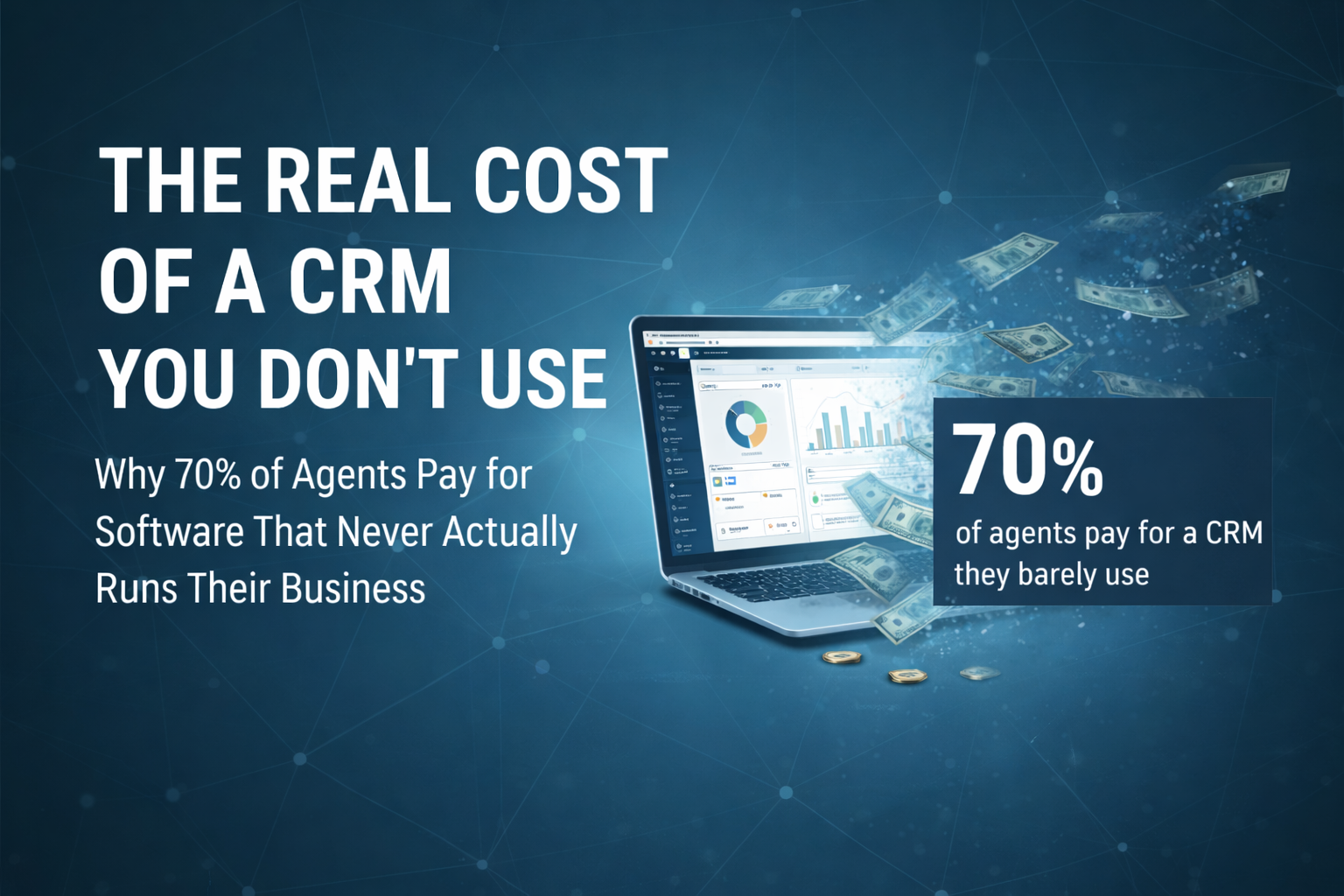
The Real Cost of a CRM You Don't Use
Ask any group of real estate agents how many of them are paying for a CRM they do not actually use, and most hands will go up. Industry research shows that over 70 percent of real estate professionals have a CRM, but fewer than 40 percent would say they are using it effectively.
This is not a technology problem. It is a design problem. CRMs were built to store data. They were not built to run your business. And when a tool requires constant attention just to function, the agents who can least afford to waste time — the ones building serious businesses — are the ones who abandon it fastest.
The question worth asking is not whether you have a CRM. It is whether your tech is working for you, or whether you are working for your tech.
The Real Reasons Agents Stop Using Their CRM
It Was Never Fully Set Up
The most common reason for low adoption is the simplest one. The agent signed up, imported a few contacts, and then got pulled back into client work before ever building out workflows, automation rules, or follow-up sequences. Without a functioning system already running, logging in feels pointless because nothing is happening inside it. You bought a tool. Nobody built you a system.
The Learning Curve Never Ends
Most CRM platforms marketed to real estate agents are genuinely complex. The feature sets are deep, the configuration options are numerous, and onboarding typically amounts to a few welcome emails and a video library. Agents who are not naturally tech-savvy give up before they ever see the value. But even tech-forward agents hit a ceiling — because configuring a CRM is not the same as building a business operating system. One requires patience. The other requires a partner.
It Creates More Work, Not Less
When a CRM is not automated, it becomes a data entry burden. Agents have to manually log calls, update lead statuses, write notes, and schedule follow-up reminders. All of that takes time most agents would rather spend closing deals. The platform that was supposed to make your business easier starts feeling like a second job. That is the opposite of growth.
It Does Not Fit How Operators Actually Work
High-performing agents are not sitting at a desktop managing a dashboard. They are on the phone, in the car, at the listing. A CRM that requires you to stop working to update it is a CRM that will not get updated. Operators need a system that captures, routes, and follows up automatically — so the work happens whether they are watching or not.
There Is No Intelligence Behind It
A CRM stores what you put in. A growth platform learns what matters. Without built-in automation that surfaces the right lead at the right time, sends the right follow-up without being asked, and keeps your pipeline moving without manual input, you are not running a system. You are maintaining a spreadsheet with a better interface.
What This Costs You in Real Numbers
If you get 20 new leads per month and your CRM usage means you are only actively following up with five of them, you are leaving 15 leads per month essentially unworked. If even 10 percent of those convert over the following year, that is 18 missed deals annually.
The problem is not that agents do not care about their leads. It is that the friction between getting a lead and consistently following up is too high when the system is not working for you. The agents who solve this problem do not find a better CRM. They stop thinking in terms of CRMs entirely — and start building on an operating platform that runs the follow-up for them.
What Actually Drives Real Adoption
Done-With-You Setup
Agents who have their system built out with someone who understands their business are dramatically more likely to use it every day. When automations are already running when you log in, contacts are imported, and workflows are configured for how you actually work, there is no setup mountain to climb. You start running your business on day one.
Automation That Works Without You
A real growth platform should do more over time, not require more from you. Automatic lead capture, AI-powered follow-up sequences, and smart alerts that surface the right action at the right time reduce friction to the point where the system runs itself. Your job is to close deals. The platform's job is everything else.
Results You Can See Quickly
Agents adopt tools when they can directly connect using the tool to a positive outcome. If your system books an appointment in the first week, you become a believer. If you go two months without a clear win, you quietly stop logging in. Fast results are not a bonus — they are the whole point.
Ongoing Partnership, Not Just Support
Most CRM companies provide support via chat or a ticketing system. What actually moves the needle is having a team that knows your specific setup, checks in proactively, and helps you optimize as your business grows. That is the difference between buying software and working with a growth partner. See how Azulio is built around this principle.
Frequently Asked Questions
How is a growth platform different from a CRM?
A CRM stores contacts and tracks activity. A growth platform automates the work that connects those contacts to closed deals — lead follow-up, pipeline management, AI-powered outreach, and ongoing optimization. The difference is not just features. It is whether the system works for you, or whether you are working for the system.
How long does it take to get fully set up?
With a done-with-you approach, a fully functioning system with automations, lead routing, and follow-up sequences can be ready in two to four weeks. Self-service setup can take months and often never gets finished.
What are the signs my current setup is not working?
You check it fewer than three times per week. You have leads with no follow-up activity older than two weeks. You cannot quickly tell who your hottest prospects are. You dread opening the app. Any one of these signals that your tech is managing you instead of the other way around.
Should I try to fix my current CRM or make a change?
If the platform is solid but your setup is incomplete, fixing it is usually faster than starting over. But if your CRM was never designed to automate your business (if it requires you to maintain it rather than running on its own) the better investment is a platform built for operators.
Can a solo agent benefit from a full operating platform?
Solo agents arguably benefit more than anyone because they are doing everything themselves. A system that handles follow-up automatically gives a solo agent the effective capacity of a small team. The goal is not to work more hours. It is to have a business that moves forward even when you are not watching.