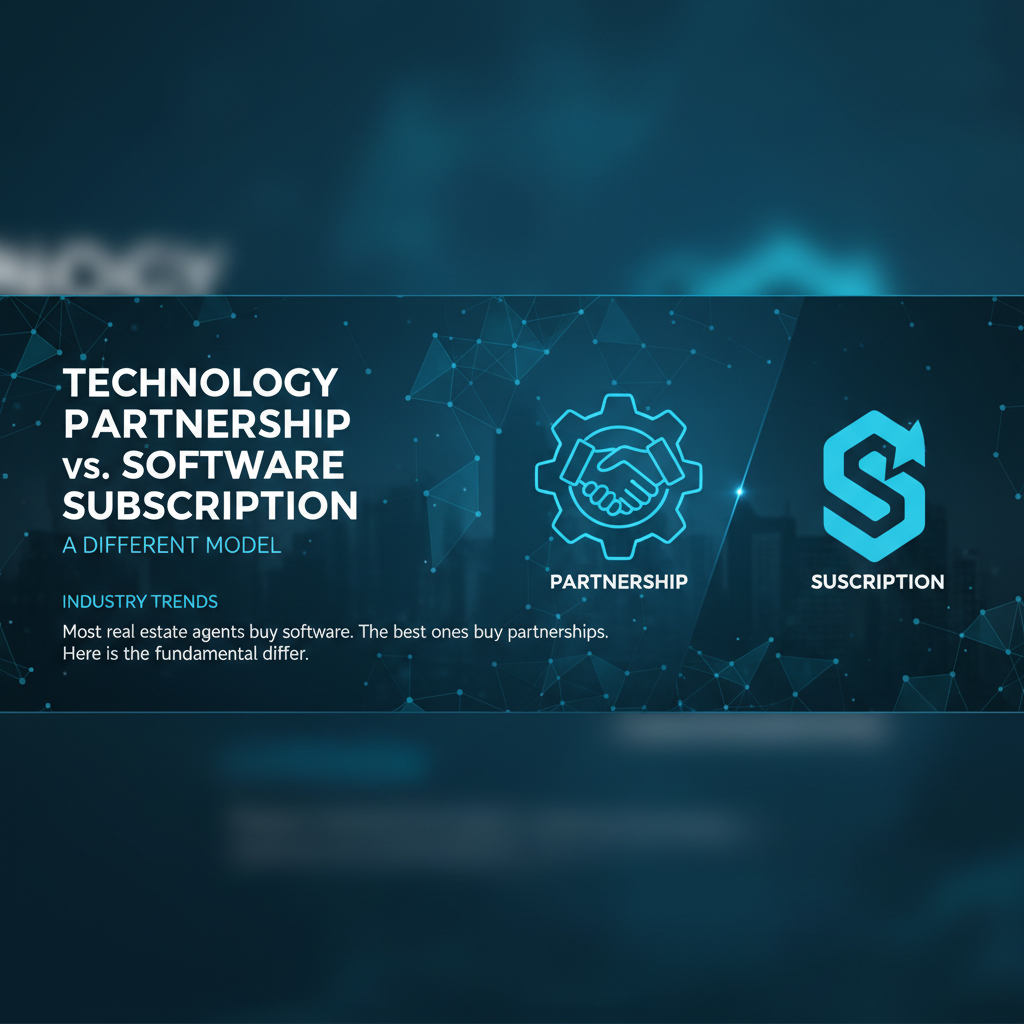
Two Ways to Think About Your Real Estate Technology
There are two fundamentally different ways to approach technology in your real estate business. The first is the software subscription model. You pay a monthly fee for access to a platform, you configure it yourself, you learn it yourself, and you maintain it yourself. The software company's job ends at delivering you a working product. Everything that happens after that is your responsibility.
The second is the technology partnership model. You pay for a relationship with a team that builds your system, maintains it, evolves it as your business changes, and takes ongoing responsibility for making sure it is working at the level of what is currently possible. The platform is still software. But the relationship surrounding it is fundamentally different.
The majority of real estate technology companies sell the first model. A small number deliver the second. Understanding the difference, and which one your business actually needs, is one of the most important technology decisions a real estate agent can make.
What the Software Subscription Model Delivers
The software subscription model delivers access to tools. The quality and capability of those tools vary significantly between platforms, but the structure of the relationship is consistent: you pay for access, you use it as you choose, and you are responsible for getting value from it.
This model works well for buyers who have the time, expertise, and motivation to configure and maintain a complex software system. It works well for businesses with dedicated operations or technology staff who can own the platform management work. It works poorly for solo agents and small teams who are managing their own business alongside their client work and do not have bandwidth for ongoing technology administration.
The software subscription model is also not designed to proactively improve your results. The company's job is to keep the software working. Your job is to figure out how to use it to grow your business. There is no one on the other side of the relationship whose success is tied to how well your system is performing.
What the Technology Partnership Model Delivers
A technology partnership delivers not just access to tools but ongoing expertise applied to your specific business. The partnership team understands your business model, your lead sources, your follow-up approach, and your goals. When new capabilities become available, they evaluate whether those capabilities would benefit your specific situation and implement the relevant ones. When something in your system underperforms, they identify it and propose a fix without waiting for you to notice and request it.
The fundamental difference is accountability. In a software subscription, the company is accountable for the software working. In a technology partnership, the team is accountable for your system producing results. These are different standards that create different behaviors and different outcomes. See how Azulio structures its technology partnership model.
How to Identify Which Model You Are Actually Getting
Many platforms market themselves as partners while delivering a subscription model. The clearest way to distinguish between them is to ask specific questions about what happens after you sign up.
Who builds the initial system configuration and how long does that take? What does ongoing support include and who is responsible for identifying problems proactively? When new AI capabilities become available, how do they reach your system? Who do you contact when something is not working the way you expected and what is the expected response time?
A genuine technology partnership produces specific, concrete answers to all of these questions. A software subscription dressed up as a partnership produces vague language about support resources and community forums. The specificity of the answers tells you more about the real nature of the relationship than any marketing description. See how Azulio compares to software subscription platforms.
Why the Partnership Model Matters More as AI Evolves
In a world where technology was relatively static, the software subscription model was more defensible. You learned the platform once, used it consistently, and the learning investment paid dividends over a long stable period. Updates were minor and manageable.
In a world where AI is producing meaningful capability improvements every few months, the software subscription model becomes increasingly inadequate for agents who want to stay competitive. Staying current requires continuous attention and expertise that most agents do not have. The partnership model handles this by having the expertise live with the team rather than requiring each individual agent to develop and maintain it independently.
The value of a technology partner who takes responsibility for keeping your system current compounds over time as the pace of AI development continues. Every update cycle that your partner team navigates without requiring your time or attention is a cycle where you stayed current without paying the self-management cost. Over years, this compounds into a substantial advantage. See how teams use the Azulio partnership model as a competitive advantage.
Frequently Asked Questions
Is a technology partnership only for large teams or high-volume agents?
No. Solo agents and small teams often benefit more from the partnership model than large teams do, because they have less internal operational capacity to cover the gaps that a software subscription leaves. The value of having a team take technology management off your plate is inversely proportional to how much spare capacity you have for that work.
What does the ongoing relationship in a technology partnership actually look like day to day?
For most agents, the partnership is mostly invisible on a day-to-day basis, which is exactly the point. Your system is running well, your leads are being handled, and you are not dealing with technology problems. The partnership becomes visible when something needs to change, when a new capability is available, or when you want to optimize something specific. You have a team you can contact and a team that contacts you when something warrants your awareness.
How do I evaluate whether a technology partner is actually producing results for my business?
Track the same metrics you would track for any technology investment: lead response time, contact rate, appointments set, and conversion rate. A genuine technology partner should be able to show you how these metrics have changed since you started working together and should be actively working to improve them over time.
Can I switch from a software subscription to a technology partnership model with my current platform?
Some platforms offer higher-tier packages that include more hands-on support, but these are often support-on-demand rather than proactive partnership. Genuine technology partnership is typically a design choice that is built into how a platform operates from the ground up, not an add-on to a self-serve subscription model.