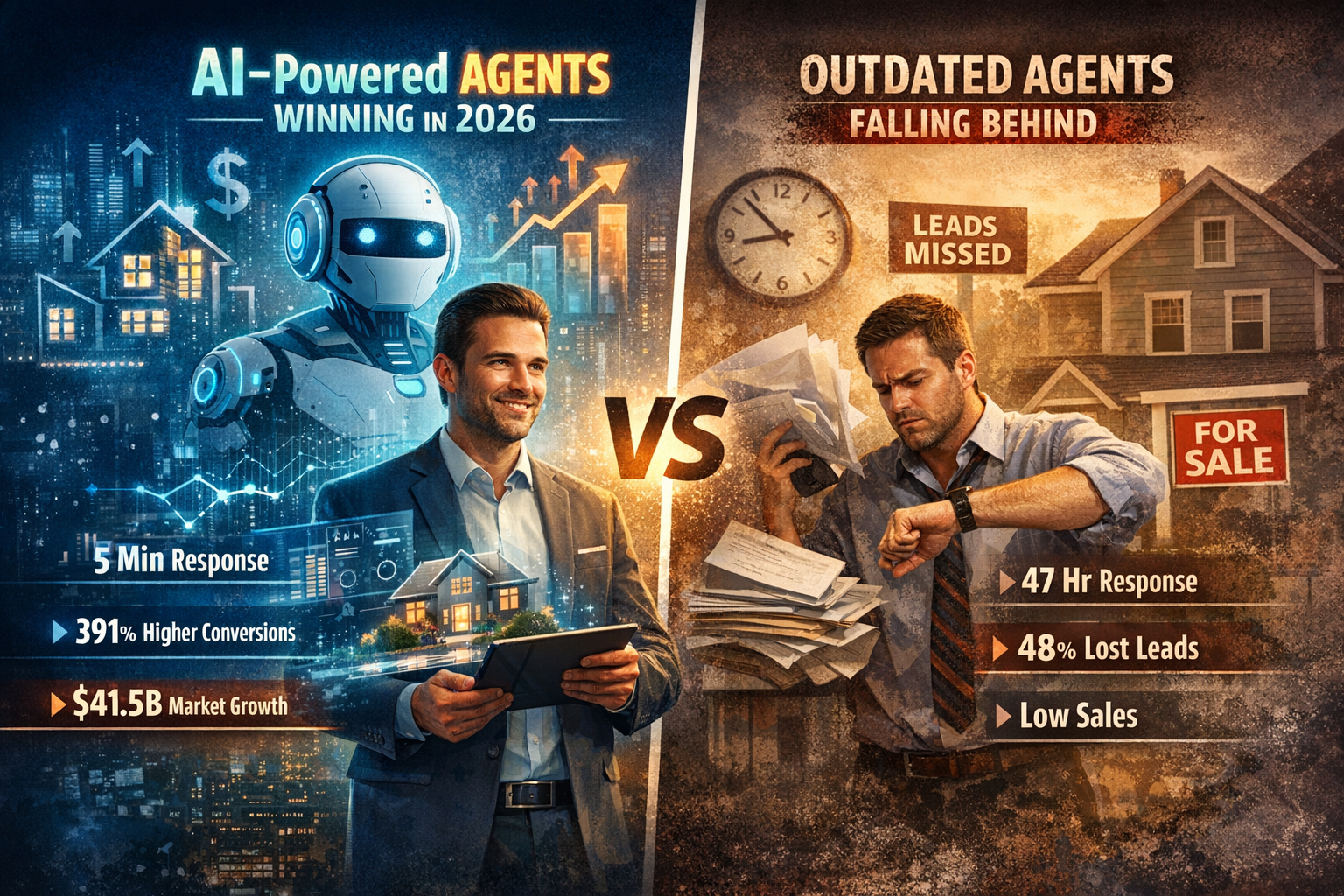
But Agents Using AI Will Replace Those Who Don't.
Every year, the same fear resurfaces: "AI is coming for our jobs."
In real estate, that fear has a specific face—the worry that algorithms will replace the trusted advisor, the local expert, the person who actually knows the neighborhood.
I think that narrative has it completely backwards.
Here's what I'm seeing on the ground: The agents who are winning right now aren't fighting AI. They're wielding it. They're showing up to listing appointments with deeper market intelligence than their competitors. They're responding to leads in seconds, not hours. They're delivering the kind of always-on responsiveness that today's consumers expect—without burning out.
The real divide in 2026 won't be between agents and AI. It will be between agents who leverage AI and those who don't.
The Numbers Don't Lie: AI Adoption Is Accelerating
The transformation isn't coming—it's already here. According to the 2024 Delta Media Real Estate Leadership Survey, 75% of America's top brokerages are already using AI, with nearly 80% reporting that their agents have adopted AI tools. This isn't experimental technology anymore. It's becoming the industry standard.
The global AI real estate market was valued at $2.9 billion in 2024 and is projected to reach $41.5 billion by 2033—a staggering 30.5% compound annual growth rate.
NAR's 2025 Technology Survey found that AI adoption has reached 68% of all agents—not just at elite brokerages, but across the industry. Two-thirds of agents say they embrace new technology primarily to save time, while 64% aim to enhance their client's experience.
The revenue impact is equally compelling. According to industry research, 63% of property companies using AI reported revenue increases following implementation, while AI is projected to drive 38% of efficiency savings in real estate by 2030.
The Speed Crisis: Why Response Time Is Everything
Here's a statistic that should keep every agent up at night: The average lead response time in real estate is 47 hours. Some studies put the average response time for real estate inquiries at 15 hours—still catastrophically slow in today's instant-response world.
Why does this matter? Because today's consumers have been conditioned by Amazon, Uber, and DoorDash to expect immediate responses. 90% of consumers now consider an immediate response as important or very important when they have a question, with the majority defining "immediate" as within 10 minutes.
According to NAR, the likelihood of connecting with a lead increases by 100 times if you call them within the first 5 minutes, compared to waiting just 30 minutes.
The data gets more stark: Research shows that 78% of leads convert to the person who responded first. The odds of qualifying a lead are 21 times greater when contacted within 5 minutes compared to 30 minutes. Yet only 7% of companies respond within that five-minute window.
The consequences? A Homeflow study found that 48% of sales inquiries go completely unanswered, representing a trove of lost opportunities. In a market where every lead counts, nearly half are slipping through the cracks simply due to slow response times.
The AI Advantage: How Technology Bridges the Gap
This is where AI becomes not just useful, but essential. AI-powered systems can respond to leads in under one minute—delivering 391% higher conversion rates compared to the industry average response time. When a prospect fills out a form at 2 AM, your AI assistant engages them immediately—while your competitors are sleeping.
The Proof Points
AI chatbots enhance lead generation by 33% according to Precedence Research. Companies with chatbots experience a 10% increase in lead conversion rates on average. One real estate company reported a 9% conversion rate from leads to booked appointments using AI tools—impressive in an industry where the average conversion rate hovers between 0.4% and 1.2%.
Housing.com achieved an 11x improvement in lead engagement and 40% faster response times through AI implementation. Professionals using automated scheduling see a 33.5% increase in appointments. AI-powered lead nurture tools have increased reply rates to over 50%—more than doubling typical email campaign performance.
Research from IBM found that chatbots can resolve up to 80% of routine inquiries, freeing agents to focus on high-value activities like negotiations and showings.
Beyond Speed: The Full Spectrum of AI Amplification
Speed to lead is just the beginning. AI is transforming every aspect of how agents serve their clients:
Market Intelligence
AI tools can predict property price trends with up to 95% accuracy, giving agents unprecedented insight into market movements. Platforms like Offrs provide leads with 72% prediction accuracy for identifying homeowners most likely to sell. This means agents can focus their time on prospects with genuine intent rather than wasting effort on tire-kickers.
Property Management & Marketing
AI-driven property management platforms can boost rental income by up to 9% while cutting maintenance costs by 14%. Virtual staging enhanced by AI increases property inquiries by up to 200% compared to traditional methods. Properties marketed with AI-driven tools see a 22% rise in sales.
Operational Efficiency
Companies using marketing automation to speed up response times have experienced a 34% rise in sales revenue. AI automation can reduce customer service costs by up to 30% while improving response quality. Companies report that AI can handle 80% of routine tasks and inquiries, freeing agents to focus on relationship-building and closing deals.
A Real-World Example: Seeing AI in Action
I watched this transformation play out in real time last week.
One of our clients activated their advertising program with Azulio. Within minutes, they were watching live as AI engaged with buyers exploring their market—answering questions, qualifying interest, building rapport. Thirty minutes later? A calendar invite hit their phone. A real meeting. A real opportunity.
All while they were focused on what they do best: serving their current clients.
That's not replacement. That's amplification.
This scenario perfectly illustrates what the data shows: AI responds in seconds while the average agent takes hours. AI qualifies leads while agents sleep. AI ensures no opportunity slips through the cracks—capturing the 48% of inquiries that typically go unanswered.
The Consumer Expectation Revolution
Understanding why AI matters requires understanding how fundamentally consumer expectations have shifted. Today's homebuyers—particularly the millennials who now account for 43% of purchases—are digital natives who dedicate 6-12 months to research before contacting an agent.
They're researching at 11 PM on their phones (73% of property searches now happen on mobile devices). They expect instant answers. They've been trained by every other industry to get what they want, when they want it.
82% of consumers consider an "immediate response" to their inquiries to be important or very important. 89% say a quick response to an initial inquiry directly influences their purchase decision.
The expectations gap is stark: 62% of CX leaders feel behind in providing the instant experiences customers expect. In real estate specifically, where the average response time stretches to 15-47 hours, the disconnect between consumer expectations and industry reality creates a massive opportunity for agents who get it right.
The Human Element: Why AI Makes Agents More Human, Not Less
Here's what the fear-mongers get wrong: AI doesn't replace the human connection in real estate. It protects it.
Think about it. Without AI, agents are forced to choose between responding to new leads and serving their current clients. They're stretched thin, stressed out, and often dropping balls. The agent who's frantically trying to respond to leads during a showing isn't fully present for either task.
76% of customers expect personalization, and 71% expect companies to recognize their individual preferences. AI handles the initial qualification, the scheduling, the routine questions—freeing agents to deliver the personalized, human touch that actually closes deals.
As JLL puts it: "We see AI as a valuable human enhancement, not a replacement." The technology amplifies what makes great agents great—their market knowledge, their negotiation skills, their ability to guide clients through one of life's most significant purchases.
The Competitive Landscape: Adopt or Get Left Behind
The numbers paint a clear picture of where the industry is heading:
-
75% of top brokerages already use AI
-
68% of all agents have adopted AI tools
-
85% of real estate firms have adopted AI to streamline operations
-
88% of U.S. firms plan to increase AI spending in the next 12 months
-
By 2028, approximately 33% of enterprise software applications will have agentic AI capabilities—up from less than 1% in 2024
The agents who wait will find themselves increasingly outpaced by competitors who respond faster, qualify better, and serve more clients without sacrificing quality. As one industry analyst noted, "The question isn't whether to adopt AI for lead generation—it's whether you can afford not to."
The Path Forward: Practical Steps for 2026
Getting started with AI doesn't require a massive technology investment or complete business transformation. Here's what forward-thinking agents are doing:
Start with Speed to Lead
Implement AI chatbots on your website for instant lead engagement. Even basic solutions can provide immediate responses while you're busy with clients. The goal is meaningful contact within minutes, not hours.
Integrate with Your CRM
Connect AI tools to your existing systems so leads flow seamlessly from first contact to scheduled showing. Automation should eliminate manual data entry and ensure zero lead drop-off.
Let AI Handle the Routine
Property questions, scheduling, initial qualification—these can all be automated. Reserve your personal attention for high-value activities like negotiations, showings, and relationship-building.
Measure and Optimize
Track your response times and conversion rates. Set goals—perhaps starting with a 15-minute maximum response window and gradually reducing it to 5 minutes or less. What gets measured gets improved.
The Bottom Line
The agents who thrive in 2026 will be the ones who understand a fundamental truth: AI doesn't make you obsolete. It makes you omnipresent. It lets you be in more places, serve more people, and deliver more value—without sacrificing the human connection that closes deals.
The technology is mature. The integrations are seamless. The ROI is proven. Every day you delay is another day competitors capture leads faster, qualify prospects better, and close more deals.
The future belongs to agents who see AI as their unfair advantage.
2026 is already shaping up to be a defining year. I hope you're ready to make it yours.
Key Statistics Summary
-
Market Growth: $2.9B (2024) → $41.5B (2033) at 30.5% CAGR
-
Industry Adoption: 75% of top brokerages, 68% of all agents
-
Speed Impact: 5-minute response = 21x higher qualification rate
-
Consumer Expectations: 90% expect immediate response; 82% within 10 minutes
-
AI Performance: 391% higher conversion with <1 minute response
-
Lost Opportunity: 48% of inquiries go unanswered; 80% of leads lost to slow follow-up